Why Your Skin Barrier Matters More Than Your Climate
My feed has been full of climate-based skincare ads lately.
Tropical creams. Alpine moisturizers. Cold-weather serums. A cream specifically formulated for my zip code, apparently. Each ad assumes that what my skin needs depends on the weather outside, and for $58 they can sell me the answer.
I keep scrolling past them. And every time I do, I land on the same thought.
Your skin barrier is the outermost layer of your skin (the stratum corneum), and it’s the thin protective wall that decides whether your skin handles whatever life and weather throw at it. The barrier is the thing that decides whether you survive a humid day in Florida or a dry month in Southern California. Not the cream. Not the climate. The barrier.
And almost nobody is selling you that.
The Climate-Based Skincare Trap
Lately I’m seeing it everywhere.
“Skincare for humid climates.”
“Tropical skincare routines.”
“Cold-weather creams.”
“Alpine moisturizers.”
Like your skin suddenly becomes a different species the moment you board a plane.
Here’s the truth: your skin doesn’t forget who it is just because you flew from Ohio to Florida. Your skin type and your barrier health matter far more than your zip code. The climate is real. The need for an entirely separate routine is not.
A healthy skin barrier adapts. A compromised one struggles in every climate, and then somebody sells you a $58 bottle to “fix” the climate.
That’s not skincare. That’s marketing dressed up as personalization.
What The Skin Barrier Actually Does
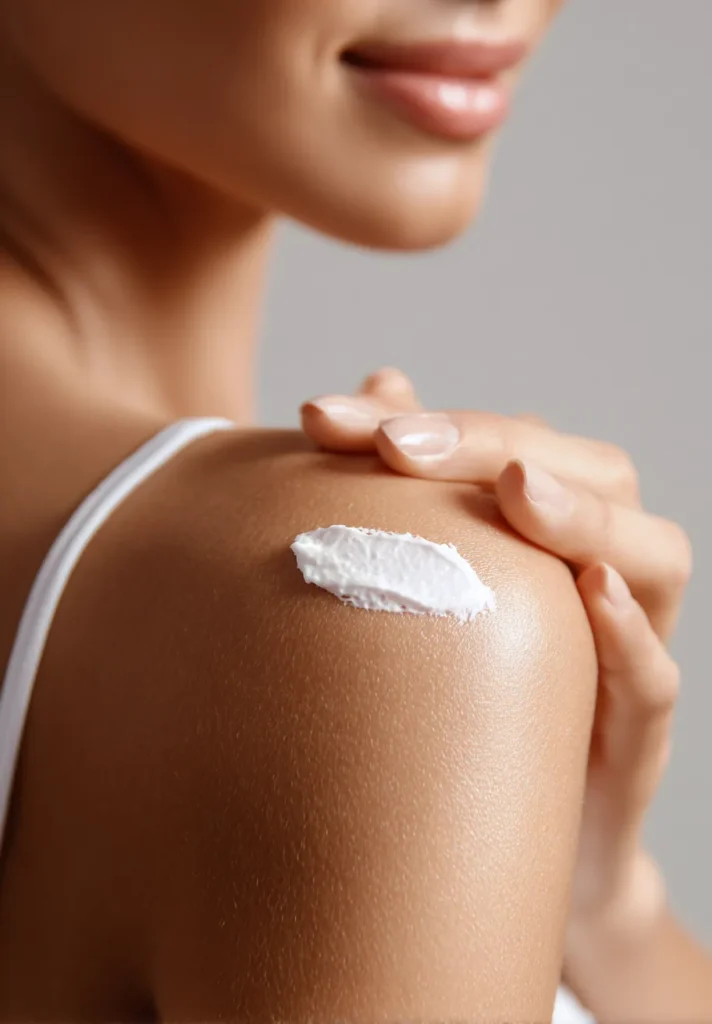
Think of your barrier as a tiny brick wall.
The bricks are skin cells (corneocytes). The mortar between them is a mix of fats: ceramides, cholesterol, and free fatty acids. The wall does three things at once. It holds water inside your skin. It keeps irritants and pathogens out. It regulates how your skin responds to temperature, sun, wind, hormones, and everything else a day throws at you.
When the wall is intact, your skin handles a lot.
When the mortar is missing, water leaks out and irritants get in. That’s when “reactive” skin shows up. Redness. Tightness. Random breakouts. The “I tried something new and now my face is mad” feeling. People blame the new product. Sometimes that’s right. More often the barrier was already compromised, and the new product just exposed it.
The Real Reason “Reactive” Skin Travels With You

I used to swap routines every season.
I thought I was being responsive to my skin. I was actually chasing symptoms.
The deeper issue was that my barrier was already compromised, and every climate was just exposing it differently.
Florida humidity made my skin look greasy and break out. Southern California’s dryness made it flake and feel tight. Same skin. Same compromised barrier. Different surface symptoms. The fix wasn’t a humid-climate cream and a dry-climate cream. The fix was repairing the barrier so it could handle both.
That’s the part the climate-based skincare industry doesn’t want to sell you.
The 5 Things Slowly Wrecking Your Barrier
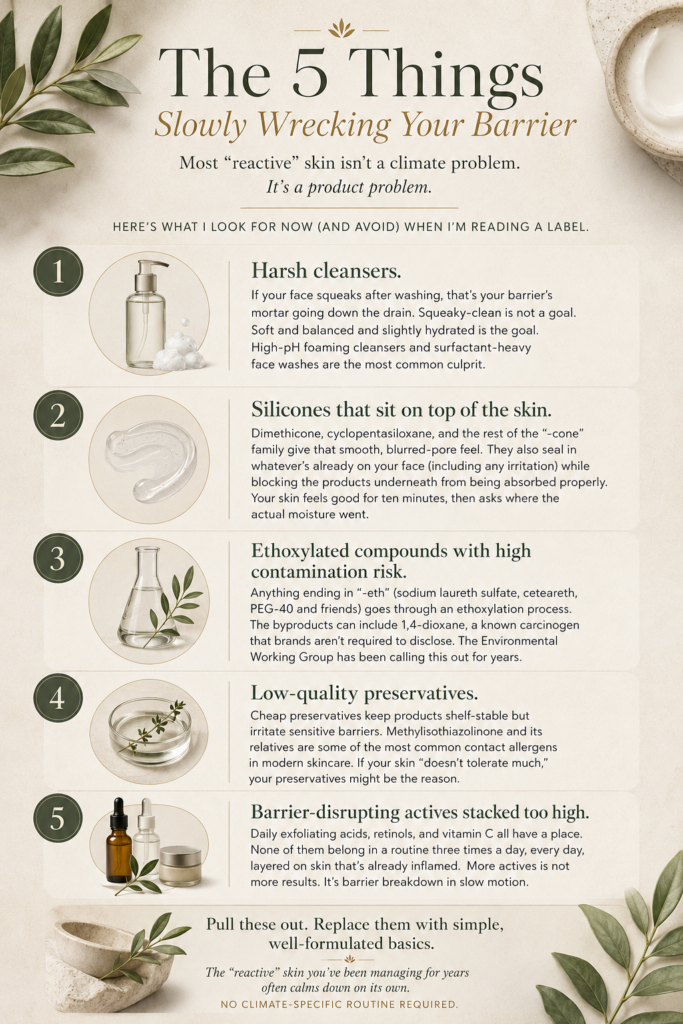
Most “reactive” skin isn’t a climate problem. It’s a product problem.
Here’s what I look for now (and avoid) when I’m reading a label.
1. Harsh cleansers. If your face squeaks after washing, that’s your barrier’s mortar going down the drain. Squeaky-clean is not a goal. Soft and balanced and slightly hydrated is the goal. High-pH foaming cleansers and surfactant-heavy face washes are the most common culprit.
2. Silicones that sit on top of the skin. Dimethicone, cyclopentasiloxane, and the rest of the “-cone” family give that smooth, blurred-pore feel. They also seal in whatever’s already on your face (including any irritation) while blocking the products underneath from being absorbed properly. Your skin feels good for ten minutes, then asks where the actual moisture went.
3. Ethoxylated compounds with high contamination risk. Anything ending in “-eth” (sodium laureth sulfate, ceteareth, PEG-40 and friends) goes through an ethoxylation process. The byproducts can include 1,4-dioxane, a known carcinogen that brands aren’t required to disclose. The Environmental Working Group has been calling this out for years.
4. Low-quality preservatives. Cheap preservatives keep products shelf-stable but irritate sensitive barriers. Methylisothiazolinone and its relatives are some of the most common contact allergens in modern skincare. If your skin “doesn’t tolerate much,” your preservatives might be the reason.
5. Barrier-disrupting actives stacked too high. Daily exfoliating acids, retinols, and vitamin C all have a place. None of them belong in a routine three times a day, every day, layered on skin that’s already inflamed. More actives is not more results. It’s barrier breakdown in slow motion.
Pull these out. Replace them with simple, well-formulated basics. The “reactive” skin you’ve been managing for years often calms down on its own. No climate-specific routine required.
What A Strong Skin Barrier Actually Needs
Less than the industry tells you.
A clean, balanced cleanser. A real moisturizer with ceramides, fatty acids, or plant oils that mimic your skin’s natural lipids. Sun protection. And a routine you can keep for months without rotating.
That’s most of it.
I use Crunchi for most of my routine because they’re EWG Verified and their formulas skip the silicones and harsh sulfates by default. Their Gentle Facial Cleanser is a soap-free, sulfate-free gel that cleanses without stripping. Their Nightlight Advanced Facial Cream is explicitly silicone-free, so it actually absorbs into my skin instead of sitting on top of it. Honey Bee by Good Medicine Beauty Labs is the face mask I reach for when the barrier needs extra help.
The point isn’t the brand though.
The point is that a strong barrier is built by what you stop doing as much as what you start doing. The same logic shows up in my nighttime skincare routine (oil before water, five steps, no rotating in trendy actives).
The Inside Half Of The Equation

Your barrier isn’t only built from the outside.
It’s built from the lipids your body produces, which depend on the fats you eat, which depend on the food you actually digest. This is where the Weston A. Price Foundation reframe lands so well for me. The fats your barrier needs (cholesterol, saturated fat, omega-3s) are exactly the fats modern food culture has been told to fear for forty years.
Pastured eggs. Bone broth. Cod liver oil. Raw or full-fat dairy if you tolerate it. Wild-caught fatty fish.
Long before there was a beauty aisle, women were eating these foods and their skin was reflecting it.
Detox water for clear skin is part of this too. Hydration with purpose, infused with vitamins and antioxidants the barrier actually uses. Plain water hydrates, but it doesn’t deliver the nutrients your barrier rebuilds with. The right ingredients in your glass support the barrier from the inside while clean products support it from the outside.
That’s the OSC framework. Inside plus outside, with the gut as the bridge.
So Before You Buy The Tropical Cream

Ask different questions.
Is my skin barrier strong, or is it compromised?
Are my products supporting it, or slowly breaking it down?
Am I eating the fats my barrier actually needs?
Am I sleeping enough that my body has time to repair?
If the answer to any of those is “no,” a humid-climate cream isn’t going to save you. And a dry-climate one isn’t either.
Repackaging the same few formulas under climate-specific labels isn’t innovation. It’s marketing. And your skin deserves better than that.
A healthy skin barrier travels with you. It adapts to Florida humidity and to Southern California dryness and to a Vermont winter. It doesn’t need a new routine every time the weather shifts. It just needs the right ingredients, on your face and on your plate, for long enough that it can rebuild.
Start with the routine. Then start with the plate.
Your skin will show you the rest.

Get Glowing Skin, From Within
Clean skin starts on the inside. Get your free guide to organic routines, skin-nourishing foods, and the products we actually trust.
No spam. Unsubscribe anytime.