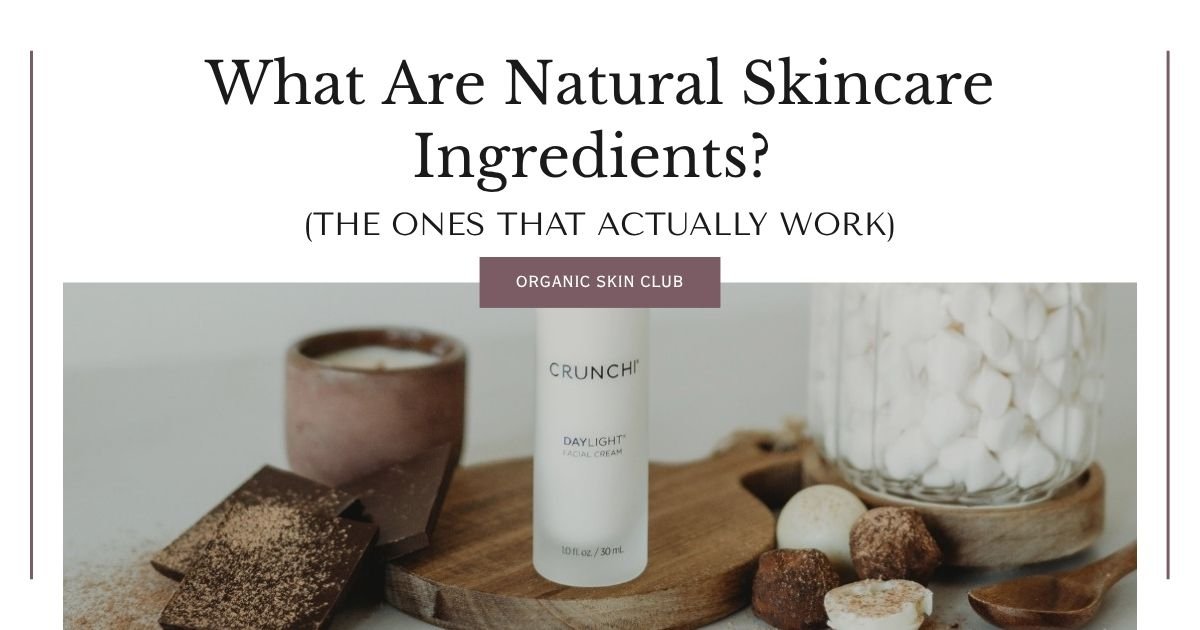
What Are Natural Skincare Ingredients? (The Ones That Actually Work)
I think about skincare the same way I think about cooking. If I’m making dinner, I want real ingredients. Things I can recognize. Things that came from somewhere I can point to on a map.
One of my favorite skincare “products” is literally just manuka honey. I put it on my face as a mask, I leave it for 15 minutes, and my skin looks better than it does after most products with 40 ingredients on the label.
Just like in the kitchen, ingredients-only is always going to be better.
But here’s where it gets tricky. Not every natural ingredient actually does something for your skin. “Natural” doesn’t mean effective.
And plenty of ingredients that sound beautiful on a label (plant-powered! botanical! farm-to-face!) are really just marketing dressed up in a garden metaphor.
On the other side, some natural ingredients have serious science behind them. Real studies. Measurable results. Decades of evidence.
The difference between a natural ingredient that works and one that’s just riding the “natural” wave? Evidence.
Today we’re breaking down the natural skincare ingredients that are actually worth your money, and the ones you can skip.
What Are Natural Skincare Ingredients?
Natural skincare ingredients are compounds derived from plants, minerals, or other naturally occurring sources that are used in skincare formulations without being significantly chemically altered. Unlike synthetic ingredients created in a lab, natural ingredients retain their original molecular structure and the beneficial compounds that make them effective.
That sounds straightforward, but here’s the catch.
There’s no legal definition of “natural” in skincare. No certification required. No standard to meet.
A product can contain one drop of lavender oil and call itself natural. The word is completely unregulated.
This is different from “organic,” which has USDA certification standards. (If you’re not clear on the difference, read What Is Organic Skincare? first.)
So when we talk about natural skincare ingredients, we’re really talking about plant-derived, mineral-derived, or naturally occurring compounds that have been studied and shown to benefit skin health.
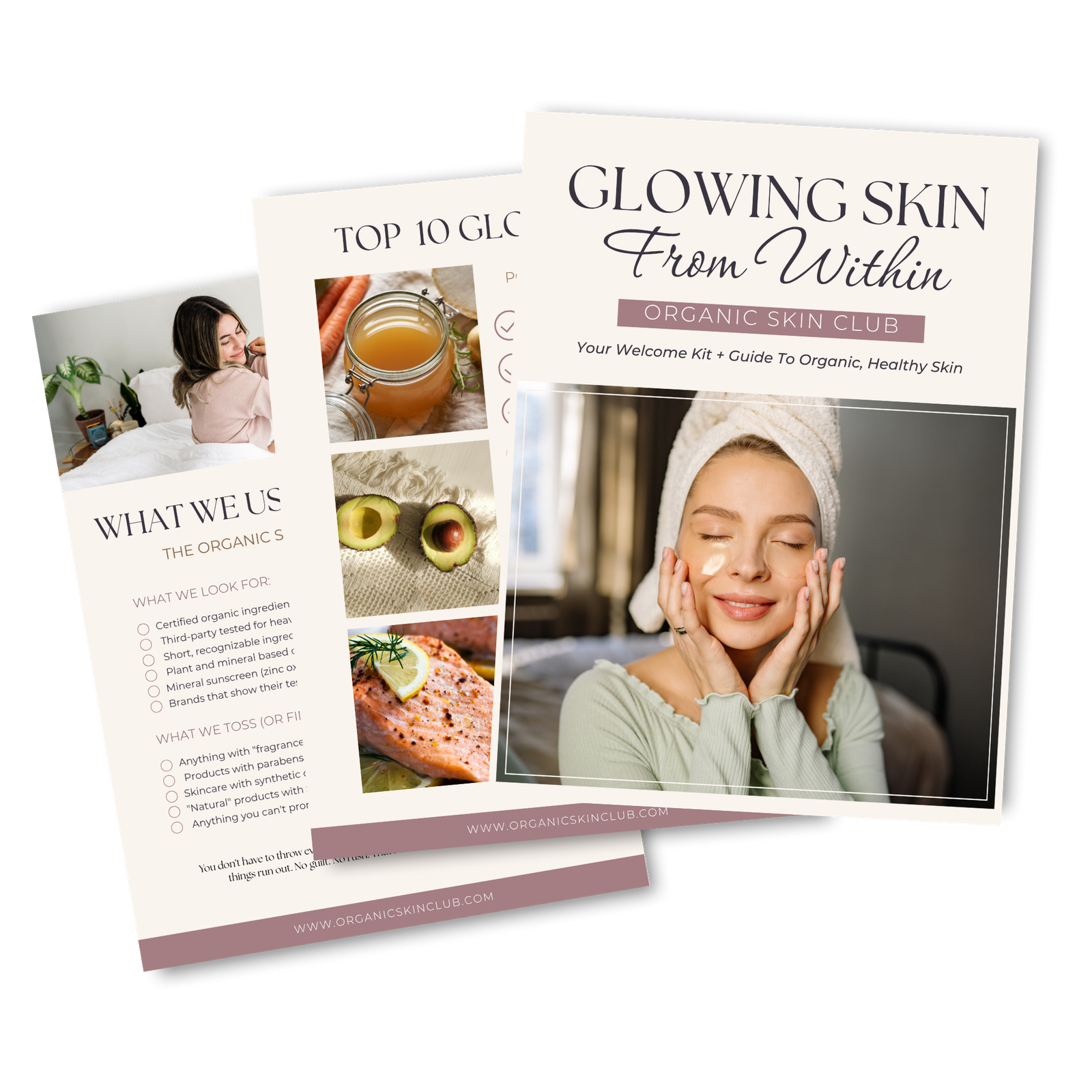
Want a quick reference of what to look for on every label? The Glow From Within Welcome Kit has a printable checklist. Join the club (it’s free) and it’s yours.
Natural Ingredients That Actually Work (Backed by Science)
Not every natural ingredient deserves a spot in your routine. These ones do.
1. Rosehip Oil
What it does: Rich in vitamins A and C, essential fatty acids, and trans-retinoic acid (a natural form of retinol).
Supports cell regeneration, fades dark spots, and improves skin texture.
The science: Studies show rosehip oil improves skin elasticity and moisture levels. The trans-retinoic acid provides anti-aging benefits similar to retinol, but with less irritation.
Best for: Aging skin, uneven skin tone, dry skin.
Look for: Cold-pressed, organic. Heat extraction damages the delicate fatty acids.
2. Jojoba Oil
What it does: Technically a liquid wax, not an oil. Its molecular structure is nearly identical to human sebum, so your skin recognizes it and absorbs it without clogging pores.
The science: Jojoba oil has anti-inflammatory properties and has been shown to enhance skin barrier function.
It balances oil production in both oily and dry skin types.
Best for: All skin types, especially oily or acne-prone (counterintuitive but true).
Look for: Unrefined, golden-colored. Clear jojoba oil has been processed and stripped of some beneficial compounds.
3. Vitamin C (Ascorbic Acid)
What it does: The most studied antioxidant in skincare. Neutralizes free radicals from UV exposure and pollution, stimulates collagen production, and brightens skin.
The science: Extensive research confirms vitamin C reduces photodamage, improves skin firmness, and helps fade hyperpigmentation.
Concentrations of 10-20% are most effective.
Best for: Dull skin, sun damage, fine lines, uneven tone.
Look for: L-ascorbic acid is the most potent form. It’s unstable though — look for products in opaque, airtight packaging. If the serum has turned brown, it’s oxidized and no longer effective.
4. Hyaluronic Acid
What it does: A sugar molecule naturally found in your skin that holds up to 1,000 times its weight in water. Draws moisture from the environment into your skin.
The science: Well-documented hydrating effects. Improves skin moisture content and reduces the appearance of fine lines through plumping.
Best for: Dehydrated skin, fine lines, all skin types.
Look for: Products with multiple molecular weights (low and high). Low-weight molecules penetrate deeper. High-weight molecules hydrate the surface.
5. Niacinamide (Vitamin B3)
What it does: Strengthens the skin barrier, reduces redness and inflammation, controls oil production, and minimizes pore appearance.
The science: One of the most versatile skincare ingredients studied.
Research shows it improves skin barrier function, reduces water loss, and decreases hyperpigmentation.
Best for: Oily skin, enlarged pores, redness, sensitive skin.
Look for: Concentrations of 2-5%. Higher isn’t always better — 10%+ can cause irritation in some people.
6. Zinc Oxide
What it does: A mineral with natural anti-inflammatory and skin-soothing properties. Also the active ingredient in mineral sunscreens (if you use one, this is the ingredient to look for over chemical UV filters).
The science: Proven broad-spectrum UV protection without absorbing into the skin. Also shown to calm irritated skin and support wound healing.
Best for: Sensitive skin, acne-prone skin, redness, inflammation.
Look for: Non-nano zinc oxide. “Non-nano” means the particles are large enough to stay on the skin’s surface rather than absorbing.
7. Bakuchiol
What it does: A plant-derived alternative to retinol. Stimulates cell turnover and collagen production without the irritation, dryness, and sun sensitivity that retinol causes.
The science: Clinical studies show bakuchiol produces comparable anti-aging results to retinol, with significantly less peeling and irritation.
It’s also safe for use during pregnancy, unlike retinol.
Best for: Sensitive skin, retinol-intolerant skin, anyone wanting anti-aging benefits without the adjustment period.
Look for: 0.5-2% concentration in serums or moisturizers.
8. Green Tea Extract (EGCG)
What it does: A powerful polyphenol antioxidant that protects against UV damage, reduces inflammation, and has been shown to support skin DNA repair.
The science: Studies demonstrate green tea polyphenols reduce UV-induced redness and prevent collagen breakdown.
EGCG is the most potent of the green tea catechins.
Best for: Sun-damaged skin, inflammation, redness, anti-aging.
Look for: Listed as Camellia Sinensis Leaf Extract on the label.
Knowing your ingredients is the first step to building a routine that actually works. This free guide connects the dots between clean ingredients, organic routines, and the foods that support your skin from within.
Get Glowing Skin, From Within
Clean skin starts on the inside. Get your free guide to organic routines, skin-nourishing foods, and the products we actually trust.
No spam. Unsubscribe anytime.
Natural Ingredients That Sound Good but Don’t Do Much
Not everything “natural” belongs in your skincare.
Coconut Oil (on your face): Great for cooking. Not great for facial skin. Highly comedogenic (clogs pores).
Fine on your body, but if you’re prone to breakouts, keep it away from your face.
Essential Oils (undiluted): Lavender, tea tree, peppermint, popular in “natural” skincare but can be potent irritants and sensitizers, especially when applied directly to skin.
If a product lists multiple essential oils high on the ingredient list, proceed with caution.
Lemon Juice: Occasionally recommended as a “natural brightener.” The pH is far too acidic for skin and can cause chemical burns and photosensitivity.
Please don’t put lemon juice on your face.
Witch Hazel: Marketed as a natural toner, but most commercial witch hazel contains alcohol that strips and irritates skin.
The alcohol-free version is gentler but not particularly effective compared to modern hydrating toners.
Charcoal: The “detoxifying” claims are largely marketing.
Activated charcoal can bind to impurities, but in a face wash that’s on your skin for 30 seconds, it’s not doing what the ads suggest.
How to Read an Ingredient List
Every skincare product lists ingredients in order of concentration, from highest to lowest. Here’s how to use that.
First five ingredients: These make up the majority of the product.
If you’re paying for “rosehip oil” but it’s the 12th ingredient after water, glycerin, and several synthetic compounds, you’re paying for the marketing, not the rosehip.
Asterisks (*): Some brands mark certified organic ingredients with an asterisk. Check for a footnote confirming this.
“Fragrance” or “Parfum”: This is a catch-all term that can represent dozens of undisclosed synthetic chemicals. Fragrance formulas are considered trade secrets, so companies don’t have to tell you what’s in them.
If you’re choosing natural skincare, fragrance shouldn’t be on the list.
Latin names: Don’t panic. Many natural ingredients are listed by their botanical Latin name.
Tocopherol is vitamin E. Helianthus Annuus is sunflower oil. The more you read ingredient lists, the more familiar these become.
The Bottom Line
Not all natural ingredients work, and not all synthetic ingredients are bad. The goal isn’t to fear chemicals. It’s to understand what you’re putting on your skin and why.
The eight ingredients above have real science behind them. They’ve been studied, tested, and shown to deliver results.
If your skincare routine includes even a few of them, you’re on solid ground.
Start by flipping over the products you already own. Read the first five ingredients. See how many you recognize.
That’s your baseline.
More to explore:
- What Is Organic Skincare? And Why It’s Not the Same as Clean or Natural
- What Is a Skincare Routine? The Exact Order, Steps, and Why It Matters
- What Is the Gut-Skin Connection? How Your Gut Health Shows Up on Your Face
Know What’s on Your Shelf
The Glow From Within Welcome Kit includes a printable checklist of exactly what to look for and what to toss in your skincare products. Plus a morning and evening routine card and the 10 best foods for skin health.
Free. Printable. Ready to use today.
→ Join the Club
Now you know what to look for on the label. The free guide helps you put it all together into a routine that works.
Get Glowing Skin, From Within
Clean skin starts on the inside. Get your free guide to organic routines, skin-nourishing foods, and the products we actually trust.
No spam. Unsubscribe anytime.